It depends on the tree
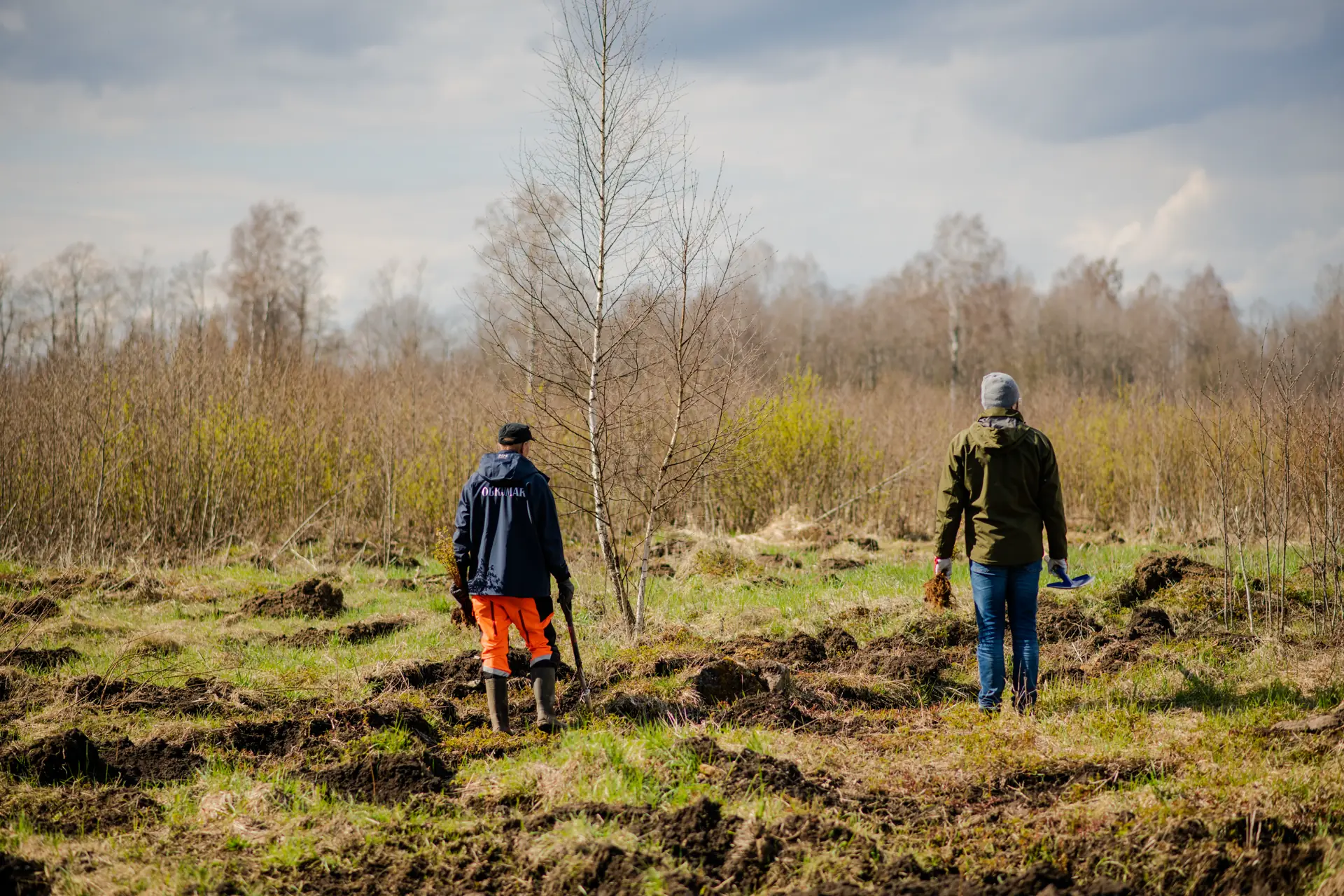
How much CO2 a tree takes up depends on its species, its age, the soil and the climate. A seedling stores very little in its first years. As the tree grows, it adds more wood every year, and with it more carbon. A forest stores most of its carbon over decades, not in its first season.
How to work it out
Trees build their wood from carbon dioxide in the air. To estimate how much CO2 a tree holds, start from the weight of its dry wood, above and below the ground. About half of it is carbon: the IPCC uses 47%. Every kilogram of carbon was once 3.67 kilograms of CO2. So a tree with 500 kg of dry wood holds about 860 kg of CO2.
What about the "22 kg a year" you see online?
It is a widely quoted figure for a grown tree, but its original source is hard to trace, and real numbers vary a lot by species, age and site. A young tree takes up far less. We would rather explain how it works than repeat a number we cannot check.
Spruce, pine and birch
We plant the three native trees of the northern forest. Birch grows fast when it is young and brings light to a new forest. Spruce and pine keep growing for a century and more, adding wood, and carbon, year after year. Together they make a mixed forest that is full of life.
Why we don't promise kilograms per tree
A tree planted this year will take decades to store most of its carbon, and every forest grows differently. That is why we talk about real trees and a growing forest, not about kilograms per order. Plant because you want more forest in the world. The carbon follows, slowly.